I Tried the Fussy Version
For six weeks there was a notebook on my kitchen counter, next to a small scale and a timer, and every morning I wrote down what I had done and what I thought of the result. The notebook was a nice one, which in hindsight was the first warning sign. The handwriting in the early entries is careful. By week four there are entries that just say fine. By week six there are three blank days and then it stops.
I want to write about that properly, because I have read a lot of accounts of people getting more serious about this and almost none about someone getting less serious on purpose.
Six weeks of writing it down
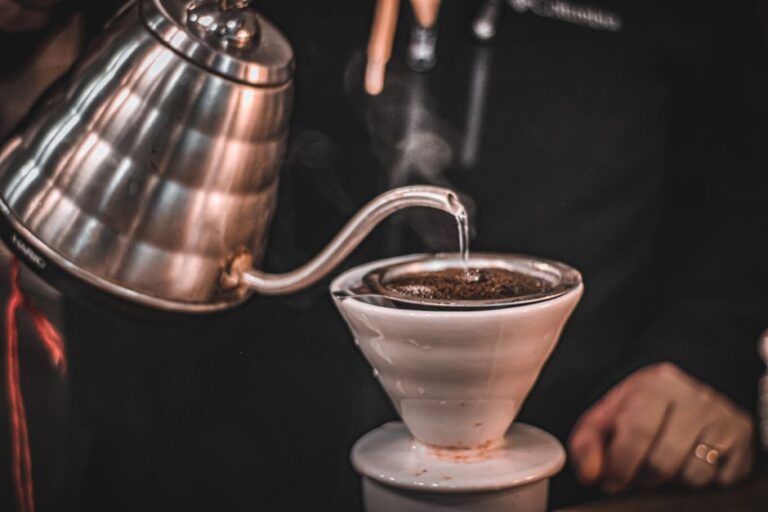
I did the whole thing. Weighed the coffee, weighed the water, timed the pour, checked the temperature with a thermometer I bought specifically, kept the notes, changed one thing at a time.
The theory is sound and I still think it is sound. If you want to improve at something, stop varying five things at once and vary one, and write down what happened, because your memory of last Tuesday’s coffee is worthless. None of that was wrong.
The first fortnight was genuinely interesting. I found out that I had been using far less coffee than I thought, and that my pour was much faster than I would have guessed, and that my sense of how long a minute is while standing in a kitchen at half six is wildly unreliable. All useful. All things I still know.
What the notebook actually told me
I sat down at the end and read it properly, expecting a trend. What I got instead was three findings, and only one of them was about coffee.
The first is that consistency mattered far more than any particular setting. The good entries were not clustered around one number. They were clustered around mornings when I had done the same thing I did the day before. Doing anything the same way twice beat doing the theoretically better thing inconsistently.
The second is that most of my adjustments were below my ability to perceive, which I had already suspected and this confirmed in writing. I have pages where I changed a variable and recorded a difference and then, later in the same notebook, changed it back and recorded a difference in the same direction. That is not data. That is me writing down what I expected to find.
The third is that my ratings tracked my mood better than anything on the counter. Bad night, mediocre coffee. Slow start with nothing urgent, good coffee. The correlation is embarrassing and it is right there in my own handwriting.
The morning I got annoyed at my own kitchen
Week five, a Thursday. I was standing at the counter with a timer running and a scale reading and a thermometer in a jug, and I looked up and realised I had not looked out of the window once, on any morning, for about a month.
The window is the reason. That is the whole thing I wrote about when I unplugged the timer machine in the first place. I had swapped a machine that did the work for me for a set of instruments that demanded I watch them instead, and both arrangements had the same result, which was that I was not present in my own kitchen.
I turned the timer off mid pour, which ruined that cup, and drank it anyway while looking at a fairly ordinary bit of street. That was the end of the notebook, although I did not know it for another week and a half.
What I kept
The scale, but only occasionally. When I open a new bag I weigh things for a couple of mornings to recalibrate my eye, and then I put it away and go by eye for the rest of the bag. Eye is close enough, and closeness is close enough.
The sequence. Six weeks of doing the same steps in the same order gave me a routine my hands run without me, and that turned out to be the actual gift of the exercise. I do not think I would have got there without the notebook.
Fresh water, tipped out and refilled. Beans that have not been open for months. Not leaving the water sitting on the grounds while I go and find something. Those three are most of the quality, and I proved it to myself in writing, which is worth more than being told.
The knowledge that I was underdoing the coffee. That was a real correction and it stuck.
What I dropped
The thermometer went in a drawer and I have not opened that drawer since. Water off the boil, left a moment while I do something else, is fine. I know I cannot detect the difference below that level because I tested it and failed.
The timer. I now go by watching, which is what the timer was a substitute for, and watching is more pleasant and about as accurate for my purposes.
The notebook. Obviously.
The idea that there is a correct version of this waiting at the end of enough adjustment. There is a floor, which is real and which is worth clearing, and above the floor there is a wide flat area where things are good and where further effort mostly produces the feeling of effort.
Where I landed
My mornings now look almost exactly like they did before the notebook, with slightly more coffee in the mug and fresher water in the kettle. Somebody watching would see no difference at all. Six weeks of instruments to arrive back at the same counter with two small corrections.
I do not regret it. You cannot get the confidence to stop fussing without having fussed, at least I could not. Every time I read something now that tells me a small adjustment will transform my mornings, I have my own handwriting to check it against, and my handwriting says the difference is smaller than the writer thinks and smaller than I could taste.
The nice notebook is in a drawer with the thermometer. I think about using it for something else and then I do not, because it has become a useful object exactly as it is, which is a record of the time I tried to solve a kitchen with numbers.