My Mornings With Someone Else in the Flat
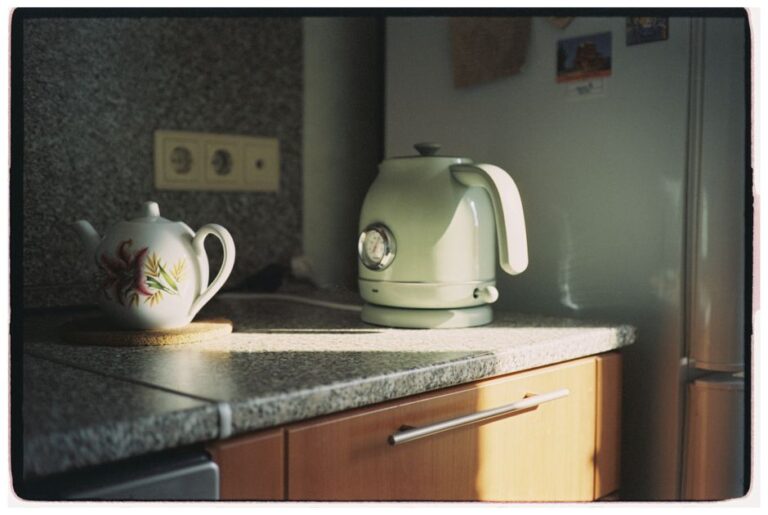
My sister stayed with me for six weeks this spring while she was between flats. She slept in the small room off the kitchen, which means the door was about three metres from the kettle, which means that on the first morning I stood in my own kitchen at half six holding a kettle and doing arithmetic about noise.
The kettle became a loud object
Things I had never heard before: the click of the switch, which is sharp; the noise the boil makes at the end, which is closer to a rattle than I realised; and the grinder, which runs for twenty seconds and is, it turns out, the loudest thing I own. I started grinding the beans the night before and leaving them in a jar. The coffee was worse. Not ruined, just flatter and a bit stale by the time water hit it, and it was a real cost rather than one I am inventing for the sake of a paragraph. Six weeks of slightly worse coffee is not a hardship. It was, though, the first time I understood that my morning had physical dimensions and that those dimensions belonged to a flat designed for one person.
I got the first two weeks wrong
My mistake was treating the hour as something to be defended. I moved around the kitchen like a person defusing something. I was extremely polite in a way that was obviously a performance of being fine, and I said the phrase “no, honestly, it is no problem” enough times that it stopped meaning anything. She noticed before I did. On about day nine she said, without any particular edge, that I did not have to tiptoe, and I heard how much tiptoeing I had been doing and how little it had bought either of us.
Defending the morning made me worse company and did not actually protect the morning. I got the sequence, the window, the coffee, and the standing, and I spent the standing part monitoring the door.
What we actually worked out
It turned out she woke at seven regardless, because of her own job, and had no particular interest in conversation before she left. So we shared the table for half an hour, most days, and did not talk. She read on her phone. I did whatever I do. At about half seven she left and I got twenty minutes on my own before I had to start.
We also fixed the grinder, which I had spent a fortnight working around. On about day twelve she mentioned that she sleeps through the bin lorry and had never once heard it. Two weeks of stale coffee and careful arithmetic, resolved by one sentence that I could have prompted at any point by asking a direct question. I think about that more often than I would like to.
This was better than the arrangement I had been trying to engineer, and on some mornings it was better than the version where I am alone. There is something in another person also not talking that I liked, which I did not expect and cannot fully account for. Twice she made the coffee, badly, and I drank it.
The part that stayed gone
Even in silence, another person in the room is a presence my attention tracks. I would hear her shift in her chair and some low level process in me would check whether that meant she wanted something. That is not a flaw in her, and it is not something either of us could have negotiated away. It is what having another person present means.
What I lost, specifically, was being unobserved. Not privacy exactly, since nothing I do at that hour is private. More the state of not being a person from anyone’s point of view for a while. I have come to think that state, rather than the coffee or the light or the sequence, is the actual content of the hour I had built. It came back the week after she left, immediately and completely, and I noticed it the way you notice a sound stopping.
What I do not know anything about
This was six weeks with an adult on a compatible schedule who was as considerate as anyone could be. I do not have children. I have never shared a flat with someone on opposite shifts, or with anyone who wakes up wanting to talk, which I understand is common and which would have broken this entirely. Anything I said about those situations would be invention, so I am leaving them alone. What I have is one data point involving one sister and a badly placed kitchen door.
What I would keep
If I lived with someone permanently, I think I would ask directly for the first twenty minutes rather than trying to arrange silence through stealth and good manners. Asking is a much smaller thing than the elaborate quiet operation I ran for two weeks, and the person I was hiding it from turned out to be entirely willing to help.
The other thing I would keep is a piece of information I did not want. The version of me with the whole silent hour is not noticeably kinder, calmer, or better at my job than the version with twenty minutes and company at the table. I had been carrying an assumption that the hour was doing more work than that. Six weeks of a shared kitchen suggests the hour is a pleasure rather than a mechanism, and I think a pleasure is enough to justify it without the extra claims.