Mending Instead of Replacing
The blue bowl broke in February, on the tiles, from about waist height, into four pieces and a scatter of small chips I kept finding for weeks afterwards with my bare feet. I put the four big pieces on the windowsill above the sink and left them there for eleven days before I did anything, partly because I was busy and partly because I did not want to admit I minded that much about a bowl.
The bowl
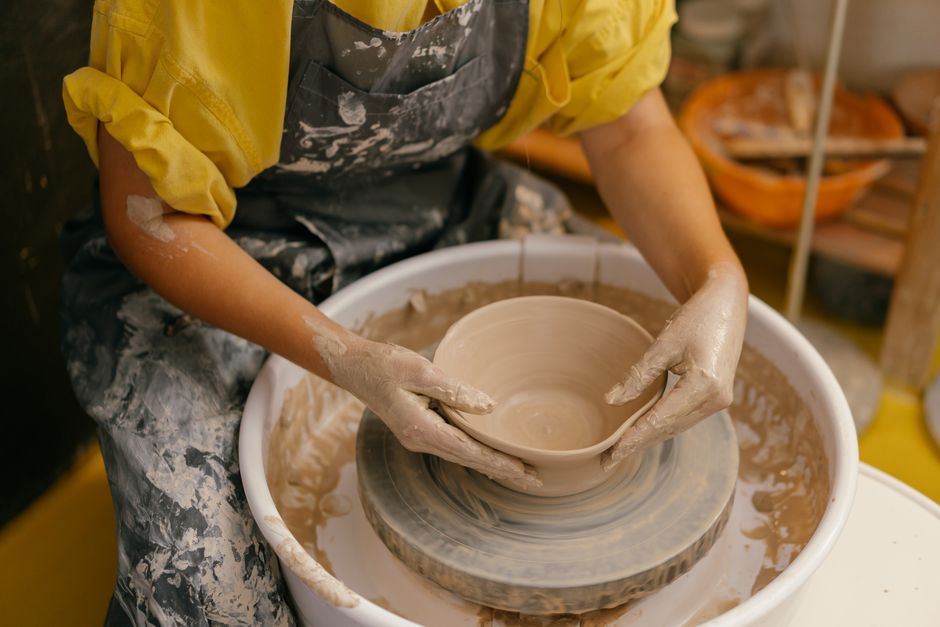
It was not valuable. I bought it at a market stall in my twenties from a woman who threw it herself and who told me, while wrapping it, that the glaze went thin at the rim on purpose. It has held every soup I have made in this flat and most of the porridge. When it broke I was holding a dishcloth in my other hand and I had been thinking about something at work, which is how most things break.
I glued it with a tube of ceramic adhesive, badly, at the kitchen table on a Sunday, with the pieces propped in a folded towel because I did not think about how to hold them until after the glue was open. There is a step at one join where the two edges did not quite meet. It holds soup. It is not going in the dishwasher again. I washed it by hand that first week with the care of someone handling an egg, and now I wash it the way I wash everything else, which I take as a sign the repair has settled.
I am not good at this
I want to be clear that I am not skilled. The chair leg I re-glued last spring is holding, but only because I do not let anyone lean back in it. The lamp I rewired took an entire afternoon and one call to my brother-in-law, who talked me through the connections while I held the phone against my shoulder. The seam I resewed on a bedsheet is visible from three feet away.
What I have got better at is the deciding part. When something breaks now, I put it somewhere out of the way and give myself a week before I do anything, because the impulse in the first hour is almost always to order a replacement, and the impulse on day five is usually calmer and cheaper and better.
Things I have decided not to mend
The toaster. It burns one side and refuses the other, and every guide I read pointed at a heating element and a set of screws I would have to reach past the mains. I gave it up. Cheap electrics with heat inside them are where my willingness stops, and I do not feel bad about that line.
The kettle, for the same reason. A pair of shoes whose sole had separated all the way to the toe, because the cobbler took one look and shook his head before I finished the sentence. A rug that the previous tenant left and that I did not like enough to have re-bound. Mending everything is not a virtue. Mending the things I would otherwise buy twice is the part that actually pays. The rough test I use is whether the fault is mechanical and visible. A loose joint, a split seam, a missing screw, a frayed cord on something that does not heat up. If I can see the problem and reach it with my hands, I try. If the problem is inside a sealed plastic case, I do not.
The drawer of spare parts
There is a drawer in the kitchen with a small bag of buttons cut off garments before they went to the charity shop, four sets of screws in labelled envelopes, a spool of grey thread, a spool of navy, a roll of self-amalgamating tape, and two of those little tubes of touch-up paint that came taped inside furniture boxes. Half of it is junk. The other half has saved me an errand at least a dozen times.
The most used item in there is the grey thread, which has closed the same seam on the same pillowcase three separate times. I have started to enjoy the fact that the pillowcase is on its third repair. It is the same pillowcase, which is the point. Linen wears at exactly one spot on that seam and I now expect it, roughly every eighteen months, the way you expect a particular stair to creak.
The jumper
In March I darned an elbow for the first time. I watched a video, got the tension wrong, unpicked it, and did it again slightly less wrong. The patch is a lighter grey than the wool around it because I used what was in the drawer, and it sits on the inside of my left arm where I see it whenever I am reading with my chin on my hand.
I thought I would mind how it looked. I do not. It looks like the jumper has been somewhere. What I did not expect is that mending it made me careful with the rest of it, in a way that buying a new one never has. I stopped throwing it over the back of a chair with the sleeves twisted.
What this is really about for me
It is not thrift, exactly, though the sums are not nothing. It is that replacing something removes the whole history along with the fault. The bowl with the step in the glue is the bowl I have eaten out of for fifteen years, and the new one, whatever it looked like, would be a bowl I had known for a week.
The repaired things in this flat are also the ones I stopped worrying about. Once a thing has a visible repair, it cannot be spoiled. That turns out to be a strange kind of relief, and it is most of the reason the glue stays in the drawer instead of a shopping list on my phone.