The Curtain Tradeoff: Privacy or Daylight
The man delivering next door’s parcel stood at my front window for about four seconds, cupping his hands round his eyes, checking whether the flat inside was mine. I was on the sofa two metres away, holding a mug, entirely visible, and neither of us acknowledged it. Ground floor living.
That was the second week after I moved in and it started a year of fiddling with curtains, which sounds like the smallest possible domestic problem and turned out to be the thing that most affected how the flat felt. Every choice about a window covering is a trade. You are deciding how much daylight you will give away in exchange for not being looked at, and there is no arrangement where you get all of both.
Attempt one: heavy curtains, half closed
The flat came with lined curtains in a dark colour. My first solution was simply to leave them half drawn during the day, which blocked the pavement view and also blocked, at a rough estimate, a third of the glass.
It worked as privacy and it was terrible as light. Worse, half closed curtains make a room look like nobody is properly living in it. I lasted about six weeks before the winter arrived and I realised I was voluntarily giving away part of a window in a flat that had very little daylight to spare.
Attempt two: nothing at all
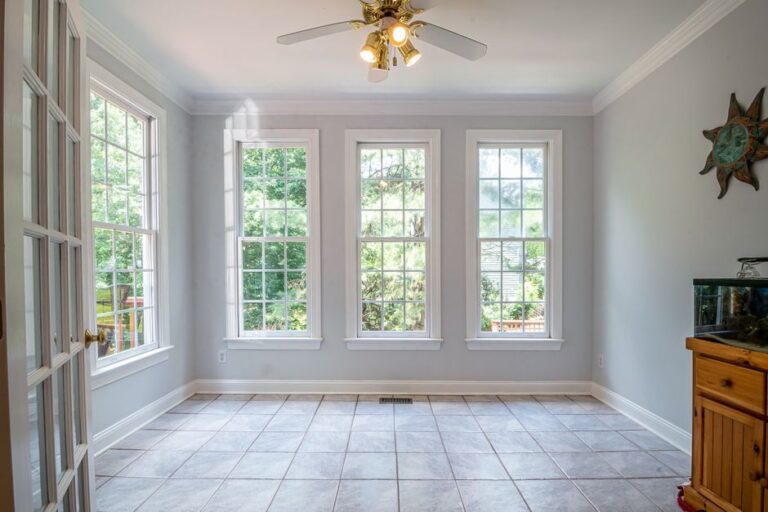
So I took them down. For most of one spring the front window had nothing on it and the room was better than it has ever been since. All the glass, all day.
I gave it up for two reasons. The obvious one is that I never entirely relaxed on that sofa. The less obvious one is the evening. From about five in the winter, a lit room with a bare window is a stage set, and you are the person on the stage, and you can see nothing outside but your own reflection. A room with no curtains has no way of closing for the night. I had not thought about that when I took them down.
Attempt three: a blind
A roller blind seemed like the sensible middle. Pull it to whatever height you need, no fabric taking up the sides of the window.
Two problems. The first is that a roller blind covers from the top down, and the part of the window I needed to cover was the bottom, where the pavement is. To hide myself from the street I had to pull it past halfway, which meant losing the top of the window, which is where most of the useful light comes from. That is exactly backwards.
The second is that the fabric I chose was not as thin as I thought. Held up to the window in the shop it looked airy. Installed, with the blind down, the room went a flat beige and I could not tell what time it was. I used it for one summer and then took it down as well.
What I actually use now
Two things, doing two different jobs, which I think is the real answer to the whole problem.
The first is a short curtain across the lower half of the window only, hung on a slim rod fixed across the middle of the frame. It is the cafe curtain idea, and I resisted it for ages because I thought it would look twee. It does not, or at least mine does not. It covers exactly the strip where a passing head is, and it leaves the entire top half of the window completely clear. The light I was losing was almost all coming from up there, and now I keep it.
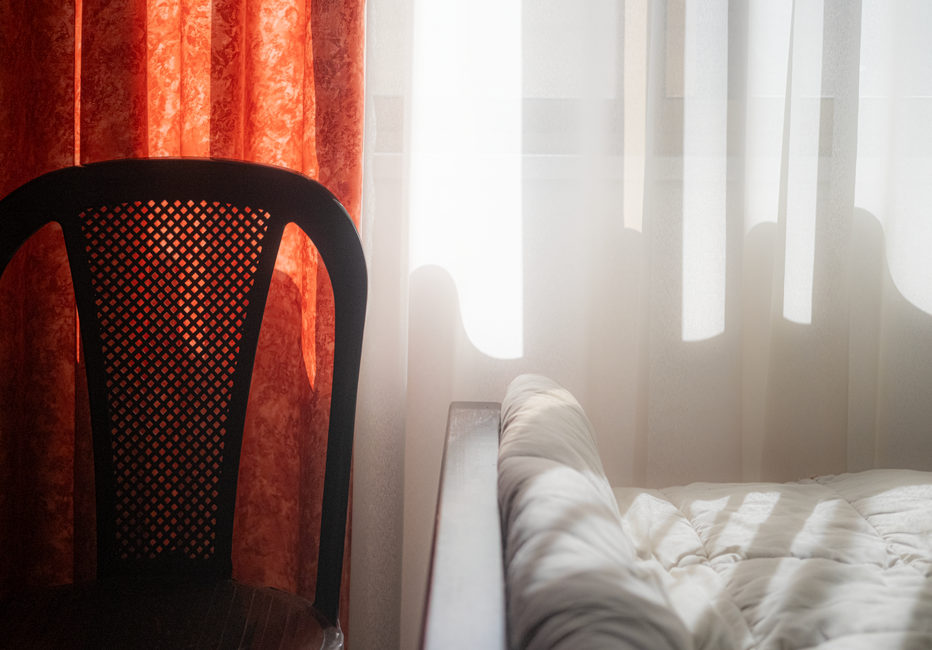
The fabric is a loose weave linen in an undyed colour. Even the covered half is not dark. On a bright day the lower half of the room gets a soft version of the same light and the upper half gets all of it.
The second thing is a proper pair of full length curtains that stay open all day and close at night. They are only there for the evening job, the closing-for-the-night job that the bare window could not do. During daylight hours they sit entirely off the glass, stacked against the wall on either side, which is the detail I got wrong for two years.
The rail is the part nobody mentions
If your curtains stack over the edges of the window when open, you are losing glass every day of the year for no privacy benefit at all. My original rail was exactly the width of the window, so open curtains covered a hand’s width of glass on each side permanently.
I put up a longer rod that extends past the frame on both sides, so the open curtains sit on the wall rather than the window. In a rented flat this means two extra holes and a conversation, and mine was fine about it. It is the cheapest daylight I have ever bought.
The same principle applies to how you hang the rod vertically. Mine sits well above the top of the window frame, which lets the curtains clear the glass at the top too.
What I would tell someone starting over
Work out which job you are solving before you buy anything. Daytime privacy from a street is a bottom-of-the-window problem. Night time closing is a whole-window problem. They are different, and one piece of fabric doing both is why so many ground floor rooms sit half dark all day.
Take the rail seriously, because it decides how much window you get back when the curtains are open, which is most of the time. And be honest about the weave. Anything you plan to leave closed during the day needs to be much thinner than you think when you are holding it up in a shop with the ceiling lights on.
I gave away a lot of daylight for a couple of years to solve a problem that only existed at about chest height.