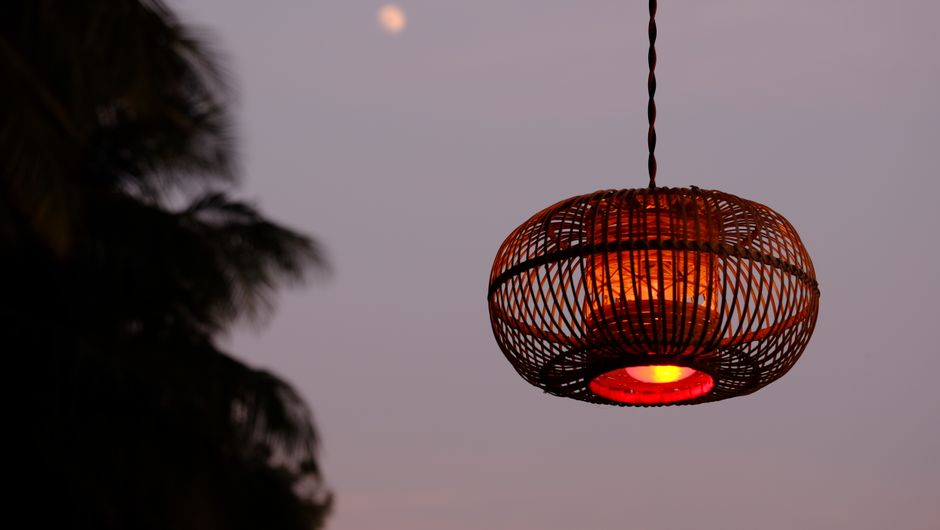
When I Turn the Lamps On
My sister came for supper in November and at about half four she said, without any edge to it, that she could not really see the potatoes. I looked up and realised I had been chopping in what was essentially dusk for twenty minutes, squinting slightly, because the light had gone down so gradually that I had followed it all the way to the bottom without noticing.
That is the hour I now think of as the handover. The daylight is finished but has not announced it, and if you are the person who has been in the room the whole time you are the last to know. Guests always know first. Their eyes have not been slowly adjusting alongside the room.
The handover happens earlier than it feels
Once I started paying attention I found that I was reliably about half an hour late. My eyes will keep coping with a dimming room long past the point where the room is pleasant, and by the time I finally reach for a switch I have usually been mildly straining for a while.
My fix is not clever. When I get up to do something else in the late afternoon, boil the kettle, take a plate through, I put the sitting room lamp on as I pass, whether or not it seems necessary yet. If it turns out to be too early, nothing bad happens. A lamp on in a room that is still bright is barely visible.
Being early is the whole trick. A room that has lamps on before it needs them never has that stretch where everyone is sitting in the grey pretending it is fine.
Why I almost never use the ceiling light
Every room in this flat came with a single bulb hanging in the middle of the ceiling, which is the standard arrangement in rented places and which I have come to think of as the light you use for finding a dropped earring.
A single overhead source lights the top of everything and the middle of the floor. It puts shadows under people’s eyes, it makes the corners of the room look darker by contrast, and it flattens all the texture out of the things I actually like looking at, the linen, the wood, the rough side of a mug.
The alternative is not complicated: two or three lamps at roughly the height you sit at, spread out. In my front room that is one by the sofa, one on the shelf across the room, and one very small one on the kitchen counter that spills through the doorway. Three modest lights beat one bright one in almost every room I have tried it in.
I do use the ceiling light in the kitchen when I am cooking properly. Chopping needs light on the board and I am not going to be precious about it.
Warmer bulbs, and how I chose them without any numbers
I want to be careful here because there is a whole world of specifications and I am not the person to give you any. I do not know the numbers and I would be making them up if I quoted them.
What I did was simple and I would recommend it. I bought two different bulbs, put them in the same lamp on two consecutive evenings, and sat in the room with each. One made the room look like a place I wanted to sit in. The other made it look like a corridor in a building I worked in once. I kept the first and went back for more of the same kind.
Packaging usually describes bulbs as warm or cool in plain words, and that description was enough for me. If you like the effect, buy several of the same thing at once, because coming back in a year and finding the range has changed is annoying in a way that is out of proportion to the object.
The other thing I did was replace bulbs across a whole room rather than one at a time. A room with two warm lamps and one cooler one looks broken and you cannot quite say why.
Different lights for different parts of the evening
The evening is not one thing and I have stopped lighting it as though it is. From about five to seven, while I am cooking and moving around and possibly still half working, I want more light and I do not mind it being practical. After eight, when the plates are washed and I am on the sofa, I want considerably less.
So the kitchen light goes off, and one of the three lamps goes off, and quite often that leaves a single lamp behind my shoulder for reading and a candle on the low table that is doing nothing useful at all except moving.
None of this is a claim about what dim light does to a person. I have no idea, and I would not tell you if I thought I did. I only know that my evenings got better when I stopped running the same lighting from four in the afternoon until bed.
The lamp that is on all day
There is one exception to all of this. My hallway has no window, and there is a small lamp on a shelf there that goes on when I get up and off when I go to bed.
I used to feel obscurely wasteful about it. Now I think a windowless room is simply a room that runs on lamps, in the same way a bathroom runs on taps, and the sensible response is to choose a lamp you like rather than to keep resenting the arrangement.
What I would change first
If someone asked me where to start, I would say: stop using the ceiling light in the room you sit in, put a second lamp somewhere across the room from the first, and switch on half an hour before you think you need to.
That is three changes, one of which costs nothing, and between them they did more for my winter evenings than the sofa did.